blog · 21 August 2026
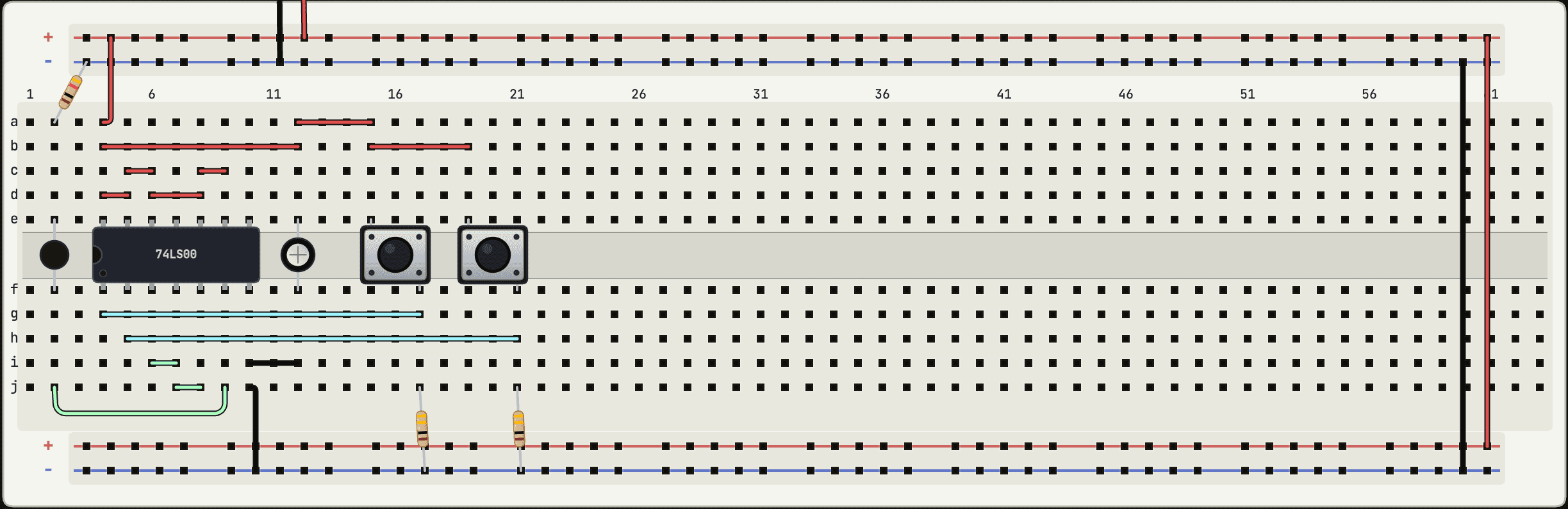
Four NANDs and a truth table: first steps with the 74LS00
Wire one gate of a 74LS00, drive it with switches, read the truth table off the LEDs, and see why NAND is the gate the others are made of.
Read updatePreparing the next de:volt page.
Product updates, practical circuit-building notes, and changelogs written for people using de:volt to learn, teach, and prototype.
blog · 21 August 2026
Wire one gate of a 74LS00, drive it with switches, read the truth table off the LEDs, and see why NAND is the gate the others are made of.
Read updateblog · 20 August 2026
A tour of the accessible canvas: reading a circuit through a screen reader, wiring with two Enter presses, nudging parts hole by hole, and the announcements that narrate your build.
Read updateblog · 19 August 2026
The touch gestures, tap-to-place flow, and layout changes that make the simulator work on iPads, Android tablets, and phones, plus the honest list of what stays mouse-only.
Read updateblog · 18 August 2026
Two sliders control the simulated world's light and temperature. Build a divider with an LDR and a thermistor, watch resistance follow the environment, and build a night light that decides for itself.
Read updateblog · 17 August 2026
Paste a textbook netlist into the import dialog and get a placed, wired, runnable breadboard. What carries over, what gets rejected honestly, and a worked RC example.
Read updateblog · 16 August 2026
What a node actually is, how hover highlighting and Show all nodes reveal your circuit's topology, and how names and annotations turn a board into a document.
Read updateblog · 15 August 2026
Wire a potentiometer to ADC0, read it with MicroPython's read_u16, and close the loop with PWM brightness on an LED. Twelve real bits, honestly scaled.
Read updateblog · 14 August 2026
What each export format is for, what the BOM's support parts are about, and which formats come with the free plan.
Read updateblog · 13 August 2026
AUTO, volts, ohms, and amps on the two-probe meter: what each mode actually computes, why current mode is picky, and what the meter honestly refuses to invent.
Read updateblog · 12 August 2026
Wire the ultrasonic sensor to a micro:bit, time its echo pulse with time_pulse_us, and check the 58 microseconds-per-centimetre arithmetic against the Inspector's distance slider.
Read updateblog · 11 August 2026
Wire the micro:bit's P0 to a real LED on a real breadboard, blink it from MicroPython, and add the breakout board when three pins stop being enough.
Read updateblog · 10 August 2026
Build the 555's one-shot mode, set the pulse width with one resistor and one capacitor, and verify T = 1.1·R·C with the scope's cursors.
Read updateblog · 9 August 2026
The scope's measurements strip and cursors, what each number actually computes, when the readout says Unavailable, and a worked PWM example where every value has a reason.
Read updateblog · 8 August 2026
Wire a potentiometer as a divider, turn the on-screen knob while the scope draws the result, and learn the difference between linear and audio taper by measuring it.
Read updateblog · 7 August 2026
Build an NPN low-side switch in the simulator, size the base resistor for saturation, and measure base and collector currents to see the whole point of the part.
Read updateblog · 6 August 2026
Wire a button and LED to the RP2040 MicroPython Board, write ten lines of machine.Pin code, and put the scope on the internal pull-up to see why the logic reads backwards.
Read updateblog · 5 August 2026
When to roll, when to trigger, what the time window buys you, and how to read the sample-rate and Nyquist numbers the scope prints about itself.
Read updateblog · 4 August 2026
Build the classic NE555 LED blinker, predict its frequency with the datasheet formula, and check the prediction against the scope's own measurement. They agree to three digits.
Read updateblog · 3 August 2026
Place a BBC micro:bit V1, flash a five-line MicroPython program, click the on-canvas buttons, and learn the Run and Restart semantics that make classroom demos predictable.
Read updateblog · 2 August 2026
Wire a push button three ways in the simulator: floating, pulled up, and pulled down. The floating version misbehaves on purpose, and the fix is one resistor.
Read updateblog · 1 August 2026
Build the classic LED-plus-resistor circuit in the simulator, size the resistor with one line of arithmetic, and then burn out a spare on purpose to see why the resistor matters.
Read updatechangelog · 31 July 2026
Build without an account and your circuit is waiting when you come back, plus a rounder, more faithful model of micro:bit audio wiring.
Read updateblog · 31 July 2026
The blog went silent for a month while the product had its busiest stretch ever. Here is the whole story, with a backfilled changelog dated to when things actually shipped.
Read updatechangelog · 30 July 2026
Three fixes from a teacher's bug report: magic links that work from any device, dialogs that never freeze the page, and micro:bit sound that requires a speaker, like the hardware.
Read updatechangelog · 18 July 2026
The simulation engine gains a sparse solver and a true small-signal AC analysis, SPICE netlists import for free, nine device families join the catalog, and the engine itself goes open source.
Read updatechangelog · 16 July 2026
Menus with visible shortcuts, real dialogs everywhere, a decluttered scope toolbar, switches that toggle without hijacking your selection, and differential probes plus net renaming for everyone.
Read updatechangelog · 13 July 2026
Scripts that clear a looping scroll before drawing now behave like real hardware, and microcontroller circuits regain their adaptive speed.
Read updatechangelog · 11 July 2026
Junction temperature, thermal shutdown, energy-based damage, real pull-up resistors on microcontrollers, honest floating-input warnings, and batteries that run down.
Read updatechangelog · 11 July 2026
Acquisition moves inside the solver at up to 10 kSa/s, the scope gains Vpp, RMS, frequency, duty, and cursors, and every number now tells you how much to trust it.
Read updatechangelog · 11 July 2026
Interactive micro:bit sensor controls, a GPIO breakout, an HC-SR04 ultrasonic sensor, searchable palette keywords, and a rebuilt Inspector across every part.
Read updatechangelog · 3 July 2026
de:volt now has a public home for product notes and user-facing release updates.
Read updatechangelog · 3 July 2026
Simulator feedback and education pilot enquiries now reach us through one clearer route, and the buck module and relay have updated component art.
Read updatechangelog · 3 July 2026
Two MicroPython boards join the catalog. Write the same code your classroom uses, run it on a simulated board, and drive real breadboard circuits with it.
Read updateblog · 3 July 2026
The de:volt blog is where product notes, circuit-building habits, and user-facing updates will land.
Read updatechangelog · 25 June 2026
Triggered acquisition with persistence, scope channels mapped to circuit nodes, PNG waveform capture, on-canvas text labels, and a public embedded circuit you can poke.
Read updatechangelog · 22 June 2026
Movable-end jumper wires, stackable rail-less boards, a 4-pin tactile button and a DPDT latching switch, plus freeform wire bending and a proper right-click menu.
Read updatechangelog · 21 June 2026
The circuit canvas gains a screen-reader representation, keyboard navigation and wiring, precise part placement, and spoken announcements for what just happened.
Read updatechangelog · 20 June 2026
Share a project and edit it together in real time, pay yearly if you prefer, and get circuit-aware hints in Learn lessons. Free-plan limits also went up.
Read updatechangelog · 20 June 2026
Touch gestures for the canvas, tap-to-place from the palette, phone-sized panels, and finger-friendly wiring land across the simulator.
Read updatechangelog · 19 June 2026
de:volt Learn gains an eight-module digital logic course, objective feedback that names what failed, fairer teacher marking, and in-product data export and account deletion.
Read update